Area & Development Guides
How to compare two developments without being distracted by the brochure
Compare the apartment, building and neighbourhood separately, using evidence and your own priorities rather than an impressive list of amenities.
By ResiPulse Editorial · 28/11/2026
Compare the home you will use
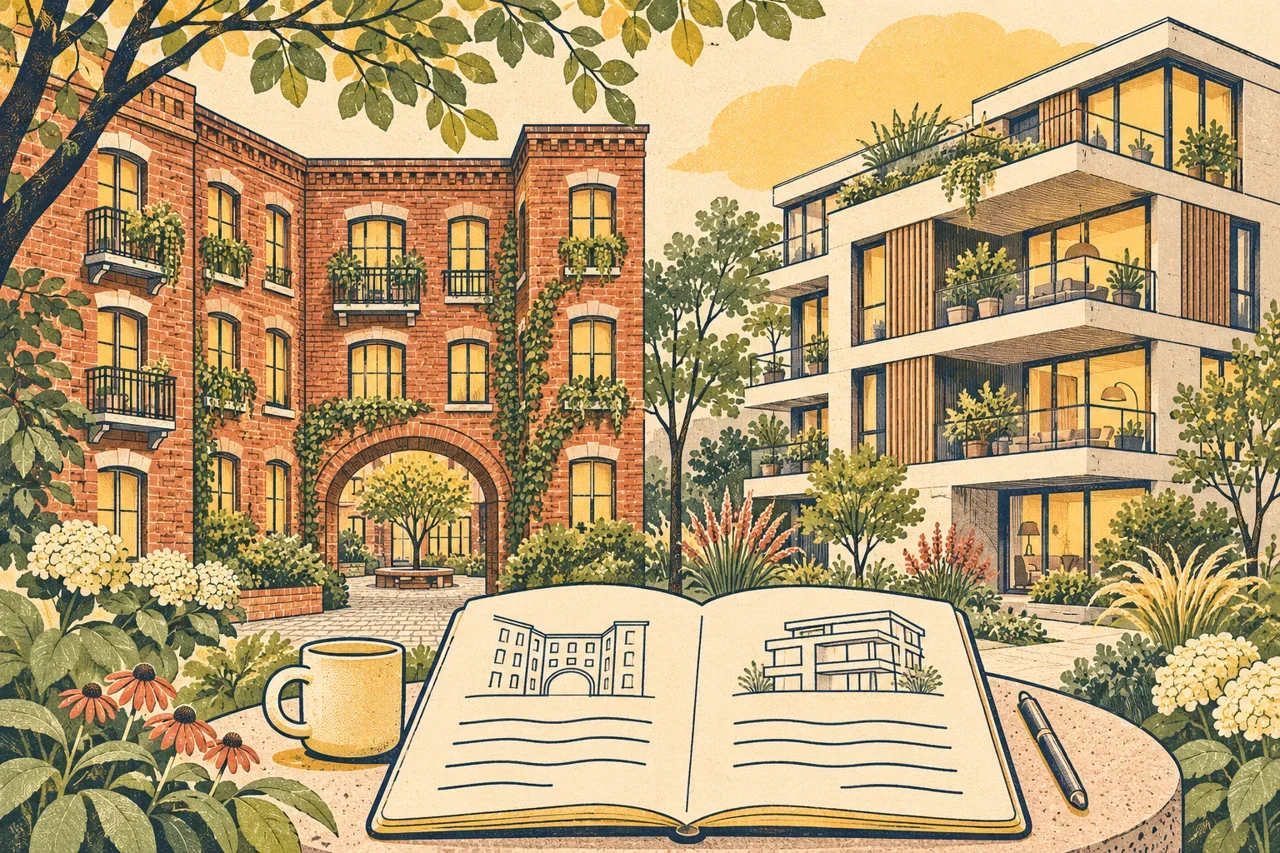
One development has a striking lobby. Another has a shorter walk to the station. A third offers a gym you might use twice a year.
A useful comparison starts with your routine and separates three things: the individual flat, the wider building and the surrounding neighbourhood.
Otherwise, a memorable feature can overshadow the details that will affect you every day.
Choose your priorities before comparing
Write down three essentials and three preferences.
An essential might be step-free access or space for two people to work from home. A preference might be a balcony or concierge service.
Be specific. “Good transport” becomes easier to evaluate when you name the journey, destination and time you usually travel.
Avoid giving every feature equal importance merely because it appears on a listing.
Use the same questions for each option
| Layer | What to compare | How to investigate |
|---|---|---|
| Flat | Layout, usable space, light and storage | Viewing and floor plan |
| Building | Access, maintenance and shared facilities | Visit and management information |
| Costs | Relevant ongoing payments and inclusions | Current documents and written clarification |
| Neighbourhood | Your journey, shops and outdoor space | Walk the routes yourself |
| Uncertainty | Important unanswered questions | Record who needs to confirm them |
Compare equivalent information. Do not put one flat’s current documented costs beside another’s undated marketing estimate without recording the difference.
Investigate amenities as services
For each facility, ask:
- Can occupants of this flat use it?
- What are the opening hours?
- Is booking required?
- Are there separate charges?
- Does it fit your routine?
A shared workspace matters less if its hours do not match yours. A cycle store matters more if you can actually use it conveniently.
Write down the practical benefit rather than simply ticking “amenity present”.
Keep evidence separate from impressions
Label each note as:
- Documented.
- Observed during a visit.
- Reported by someone else.
- Not yet confirmed.
A resident’s experience can help you identify questions. It does not automatically describe the experience of every household.
Likewise, missing information should remain an open question, not become a positive or negative score.
Revisit the trade-off
After comparing, complete this sentence for each option:
“This development suits me because ___, but I still need to confirm ___.”
If the answer is mainly about the brochure photography, revisit the practical questions.
If you are buying a leasehold flat, building comparison is only one part of the decision. Use the Leasehold Advisory Service’s buying checklist alongside your solicitor’s checks and an appropriate survey.
Use ResiPulse to explore available development information, then verify the details that matter to the specific flat. Availability and completeness of information can vary between buildings.
Related reading
Buying a flat? Check the building as carefully as the apartment